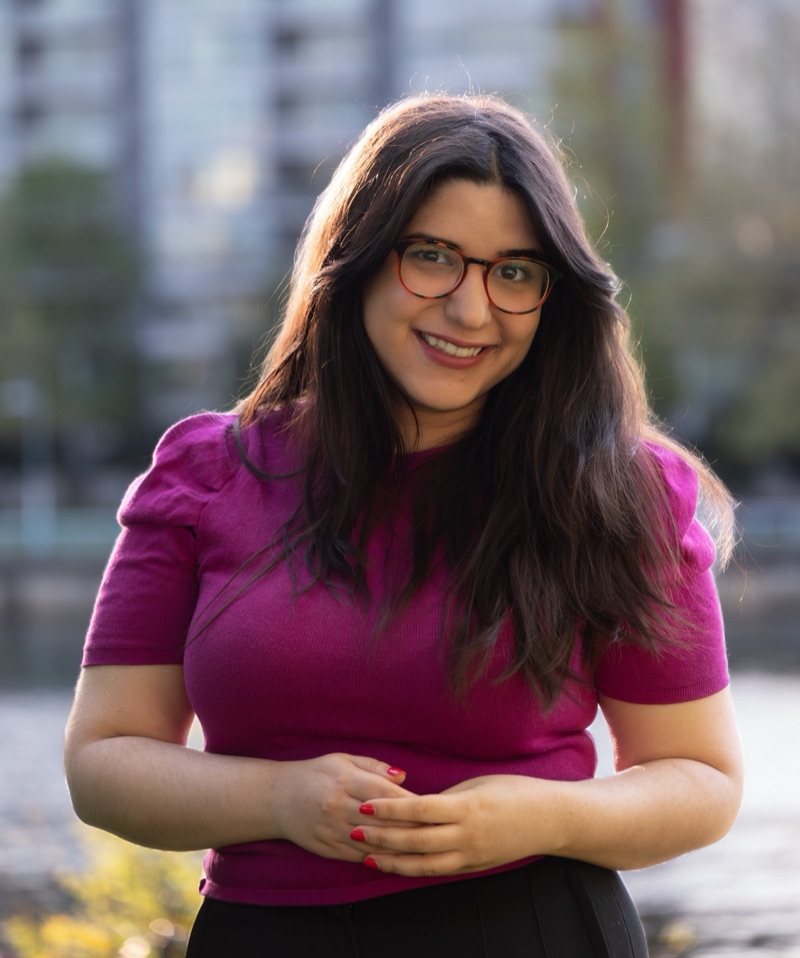
I am a Ph.D. candidate in Clinical Psychology at the University of British Columbia, where I work in the PEARL Lab (Promoting Equitable, Affirming Relationships Lab) with Dr. Amori Yee Mikami. I study how people use the internet and how it shapes their mental health, relationships, and safety. My dissertation looks at how people search for information about ADHD online, how that content affects what they believe and do, and how clinicians can respond to it.
As a therapist, I take a collaborative, warm, and evidence-based approach. I combine cognitive-behavioural techniques with compassion-focused strategies so that treatment fits the person in front of me. I have trained in CBT, DBT, and psychodynamic therapy, and have worked with individuals, couples, and groups on anxiety, depression, OCD, trauma, and relationship and sexual health concerns.
I grew up in Greece, and I pay close attention to how culture shapes the way people understand themselves, their relationships, and their sexuality. Before UBC, I completed an M.A. in Psychology (forensic stream) and undergraduate degrees in Psychology and in Neuroscience & Mental Health at Carleton University.
Research
My work falls under what I call digital citizenship, meaning how people interact with the online world and what that does to their lives. I have three lines of research:
- Mental health information online. How people find and evaluate ADHD content on platforms like TikTok, how it shapes self-perception and attitudes toward treatment, and how social media can be used in ways that support wellbeing.
- Online sexual communication and consent. How consent is communicated, assumed, or ignored in sexting and other digital sexual encounters.
- Technology-facilitated sexual violence. Non-consensual sharing of intimate images, cyberflashing, and AI-generated (deepfake) sexual content: why people do it, how survivors are affected, and where the law falls short.
Selected publications
A full list is on Google Scholar.
- Karasavva, V., Khalis, A., & Mikami, A. Y. (2026). How, not just how much: Bidirectional associations between social media use and psychopathology. Journal of Social Media Research. [link]
- Karasavva, V. (2025). The frequency, nature, impact, and coping strategies of non-consensual intimate image dissemination victimization: A scoping review. Trauma, Violence, & Abuse. [link]
- Karasavva, V., Miller, C., Groves, N., Montiel, A., & Mikami, A. Y. (2025). A double-edged hashtag: Evaluation of #ADHD-related TikTok content and its associations with perceptions of ADHD. PLOS ONE. [link]
- Swanek, J.*, Karasavva, V.*, Burnet, L., Sohail, R., & Forth, A. (2025). “It’s not that serious”: Individual and situational factors that influence perceptions of online versus in-person sexual coercion. Computers in Human Behavior. [link]
- Mikami, A. Y., Khalis, A., & Karasavva, V. (2024). Logging out or leaning in? Social media strategies for enhancing wellbeing. Journal of Experimental Psychology: General. [link]
- Karasavva, V., & Mikami, A. Y. (2024). I’ll be there for you? Bystander intervention in cyber aggression. Cyberpsychology: Journal of Psychosocial Research on Cyberspace. [link]
- Karasavva, V., Burnet, L., Smodis, A., Swanek, J., & Forth, A. (2023). Putting the Y in cyberflashing: Exploring the prevalence and predictors of the reasons for sending unsolicited nude or sexual images. Computers in Human Behavior. [link]
- Karasavva, V., & Noorbhai, A. (2021). The real threat of deepfakes: Policy review and suggestions. Cyberpsychology, Behavior, and Social Networking. [link]
* Shared first authorship.
Media
Our 2025 study of ADHD content on TikTok was covered by The New York Times, NPR, CBC, Scientific American, ABC News, The Globe and Mail, New Scientist, The Independent, the Toronto Star, CTV, and Euronews. I have also spoken with Radio-Canada and The Canadian Press about deepfake sexual content.
Some things I have written for a general audience:
- Put a finger down if TikTok has made you think you have ADHD, The Conversation, 2025
- Scroll less, connect more, SPSP Character & Context, 2025
- Why bystanders don’t always speak up against cyberbullies, SPSP Character & Context, 2024
Honours
- 2025 Trudeau Foundation Doctoral Scholarship, finalist
- 2023 Vanier Canada Graduate Scholarship
- 2023 SSHRC Canada Graduate Scholarship – Doctoral (ranked 1st of 144)
- 2018 University Medal in Arts, Carleton University
- 2018 Senate Medal for Outstanding Academic Achievement, Carleton University
Contact
Email is the best way to reach me: vkarasavva@psych.ubc.ca
Department of Psychology, University of British Columbia
2136 West Mall, Vancouver, BC V6T 1Z4